Fake News & Follow the Money
The Concept
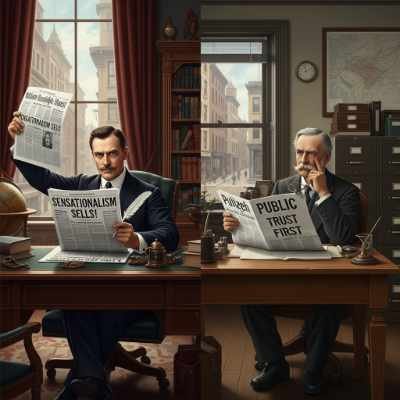
“Fake News” was not invented in 2016. It was invented in the 1890s. To understand modern clickbait, you must understand its ancestor: Yellow Journalism. The goal has never been “Truth”; the goal has always been “Circulation” (selling ads).
Part 1: The History (Yellow Journalism)
The Origin Story In the late 19th century, two media tycoons—Joseph Pulitzer and William Randolph Hearst—were fighting a war for readers in New York. To sell more papers, they stopped reporting facts and started manufacturing outrage. They used sensational headlines, exaggerated drawings, and terrified the public to keep them buying. This style became known as “Yellow Journalism.”
The “Spanish-American War” Hoax When artist Frederic Remington telegraphed Hearst from Cuba saying there was no war to cover, Hearst famously replied:
“You furnish the pictures and I’ll furnish the war.” Hearst’s papers then published fake stories of Spanish atrocities, whipping the US public into a frenzy that literally started a war.
-
The Lesson: The media does not just report conflict; they often create it because conflict sells.
Part 2: The Verification Toolkit
Modern “Fake News” usually involves taking a real video from 5 years ago and claiming it happened today. Here is how you check.
1. Reverse Image Search
-
The Tool: Google Images (click the camera icon) or TinEye.com.
-
The Drill: Take a screenshot of the “shocking” video. Upload it. If the image appears in a story from 2015, the current headline is a lie.
2. The Weather Check
-
The Drill: If a video claims to be “Live from London,” look at the sky. Is it sunny in the video? Check the weather report for London right now. If it’s raining in reality but sunny in the video, it is fake.
3. The “Cross-Reference” Rule
-
The Drill: If a story is true, multiple rivals will cover it (AP, Reuters, BBC, Al Jazeera). If only one obscure blog is reporting it, it is likely a fabrication or a leak that hasn’t been verified.
Part 3: The Taxman (Follow the Money)
Media companies are not public services; they are corporations with shareholders and tax liabilities.
The “Self-Promotion Bias” A newspaper will rarely investigate the corruption of its own parent company.
-
Example: If a TV network is owned by a defense contractor, do not expect unbiased reporting on the military budget.
-
Example: If a paper is owned by a tech billionaire, do not expect unbiased reporting on tax loopholes for tech companies.
The “Tax Haven” Check When a media outlet lectures you on “Patriotism” or “Paying your fair share,” check where they are registered.
-
Many global media conglomerates utilize offshore tax havens (like Delaware, Ireland, or the Cayman Islands) to minimize their own tax bills.
-
The Lesson: Listen to their financial reports, not their editorials. The financial report tells you who they actually work for.
Action Item: Who Owns It?
Pick the news site you visit most often. Scroll to the very bottom of the homepage or check their Wikipedia “Owner” section.
-
Who owns them? (Is it a hedge fund? A billionaire? A government?)
-
What else do they own?
-
Does that conflict with the news they report?