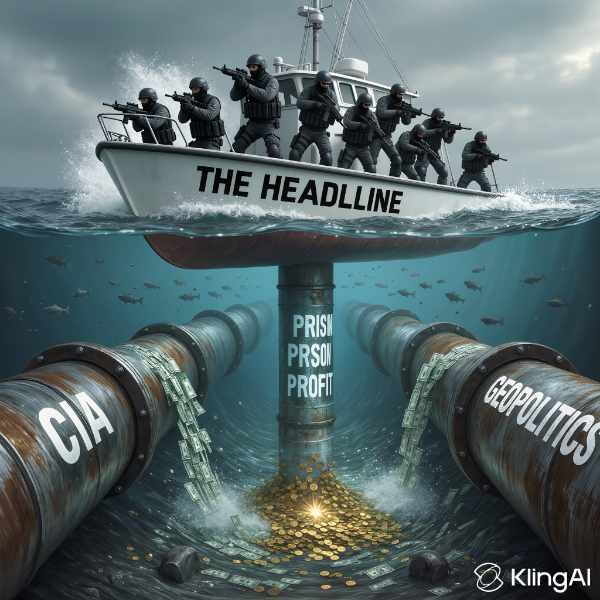
TRADECRAFT: The “Drug War” Smoke Screen
The Concept
Whenever a government screams “DRUGS,” stop looking at the drugs. Look at the money, the map, and the prisons. “The War on Drugs” is rarely about public safety. Historically, it is a tool used to:
-
Justify foreign intervention (The Geopolitical Motive).
-
Target specific domestic groups (The Political Motive).
-
Fuel private industries (The Profit Motive).
CASE STUDY: The 2026 Paradox (Venezuela vs. The Pardons)
Analyzing the disconnect in the current administration’s narrative.
The Headline: The Administration justifies the invasion of Venezuela and the bombing of fishing boats as a necessary war to stop Fentanyl entering the US.
The Glitch (The Reality Check): At the exact same time as this “Zero Tolerance” war, the same Administration issued pardons to documented drug traffickers:
-
Juan Orlando Hernández (Dec 2025): The former President of Honduras, convicted of facilitating 400 tons of cocaine into the US. Pardoned.
-
Garnett Gilbert Smith (May 2025): A Baltimore kingpin convicted of distributing 1,000 kg of cocaine. Pardoned.
-
Ross Ulbricht (Jan 2025): Founder of Silk Road. Pardoned.
The Verdict: If the goal was “stopping drugs,” you would not pardon the wholesale suppliers. The “Drug War” in Venezuela is a Smoke Screen for regime change and resource control.
DEEP DIVE: The 4 Models of State Involvement
History proves the state is often the trafficker, not the enforcer.
1. State-Enforced Trafficking (The Opium Wars)
-
The Narrative: “Free Trade.”
-
The Reality: In the 1840s, Britain went to war to force China to buy opium. When China tried to stop addiction, Britain bombed them. The drug trade was a tool of Empire wealth transfer.
2. Covert Facilitation (The CIA Model)
-
The Narrative: “Fighting Communism.”
-
The Reality: From the French Connection (1950s) to the Golden Triangle (Vietnam) to the Contra Wars (1980s), intelligence agencies have repeatedly tolerated or facilitated drug trafficking by their “allies” to fund off-the-books wars.
3. The “Prison-Industrial” Model (The US Model)
-
The Narrative: “Tough on Crime.”
-
The Reality: Private prison companies (like CoreCivic) lobby for stricter sentencing because their business model depends on high occupancy. The “War on Drugs” is a supply chain for the prison industry.
4. The Public Health Model (The Portugal Model)
-
The Narrative: “Harm Reduction.”
-
The Reality: In 2001, Portugal decriminalized everything. The result? Overdose deaths dropped. HIV rates dropped. Treating addiction as a medical issue works; treating it as a war creates profit for cartels and prisons.
TRADECRAFT INSIGHT: The “Neil Woods” Rule
Field notes from a former Undercover Narcotics Officer.
Neil Woods, a veteran undercover cop, infiltrated the most dangerous gangs in the UK. His conclusion breaks the entire narrative:
“After an operation where we arrested 96 people—every single dealer in the city—we interrupted the drug supply for exactly two hours.”
The Tradecraft Takeaway:
-
Policing never reduces the size of the market. It only changes the shape of the market.
-
When you arrest a “Kingpin,” you create a job vacancy. This leads to a “Turf War” (violence) as rivals fight for the spot.
-
Police Corruption is Inevitable: The profits are so high that organized crime can buy any institution. As Woods noted, “We need to legalize drugs to take the power away from the Cartels. You cannot fight market forces with handcuffs.”
LAB EXERCISE: Audit the “Record Bust”
Task: Find a news story today about a “Record Drug Bust.”
-
Look at the Street Value: Police always inflate this number (using the highest possible street price) to make the bust look bigger.
-
Look at the Impact: Did the price of drugs in that city go up the next day? (Rarely).
-
Ask the Question: Who benefits from the vacancy this arrest created? Usually, a rival cartel or a state-sponsored group.